
There are plenty of window managers for macOS, ranging from simple window snapping utilities to complex tiling window managers inspired by i3 and other Linux alternatives.
Personally, I prefer something simpler. An application that allows me to move and resize windows using keyboard shortcuts without having to rethink my entire workflow.
Rectangle is exactly that. A free and open source window manager for macOS that lets you organize your windows using customizable keyboard shortcuts and mouse gestures.
Last updated: November 20, 2026.
What Is Rectangle?
Rectangle is a native macOS application written in Swift and distributed under the MIT license. It’s based on Spectacle, a previously popular open source window manager that is no longer maintained.
Affiliate promotion. FSMdotCOM may earn a commission.


Unlike automatic tiling window managers, Rectangle primarily lets you decide when and where your windows should move.
Its main features include:
- Move and resize windows using customizable keyboard shortcuts.
- Snap windows to screen edges and corners.
- Arrange windows into halves, thirds, quarters and other predefined layouts.
- Maximize, center or restore windows to their previous dimensions.
- Move windows between connected displays.
- Arrange multiple windows into rows or columns.
- Cycle through overlapping windows using configurable shortcuts.
- Customize window gaps and snapping behavior.
Rectangle runs in your menu bar and doesn’t require an account or subscription.
Download and Install Rectangle
The latest stable release at the time of this update is Rectangle 2.0.4, released on October 20, 2026.
The current version requires macOS Sonoma 14 or later and supports Intel and Apple Silicon Macs.
Download Rectangle from its official website or GitHub releases page. Open the downloaded DMG file and drag Rectangle into your Applications folder.
Alternatively, if you already use Homebrew, install it with:
brew install --cask rectangleIf you’re running an older version of macOS, the following legacy releases remain available:
| macOS version | Rectangle version |
|---|---|
| Sonoma 14 and later | Current release |
| Catalina 10.15 through Ventura 13 | 1.100 |
| High Sierra 10.13 and Mojave 10.14 | 0.73 |
Grant Rectangle Accessibility Permission
When you launch Rectangle for the first time, macOS will ask you to grant Accessibility permission. Rectangle needs this permission to move and resize windows belonging to other applications.
On recent versions of macOS, navigate to System Settings > Privacy & Security > Accessibility and enable Rectangle.
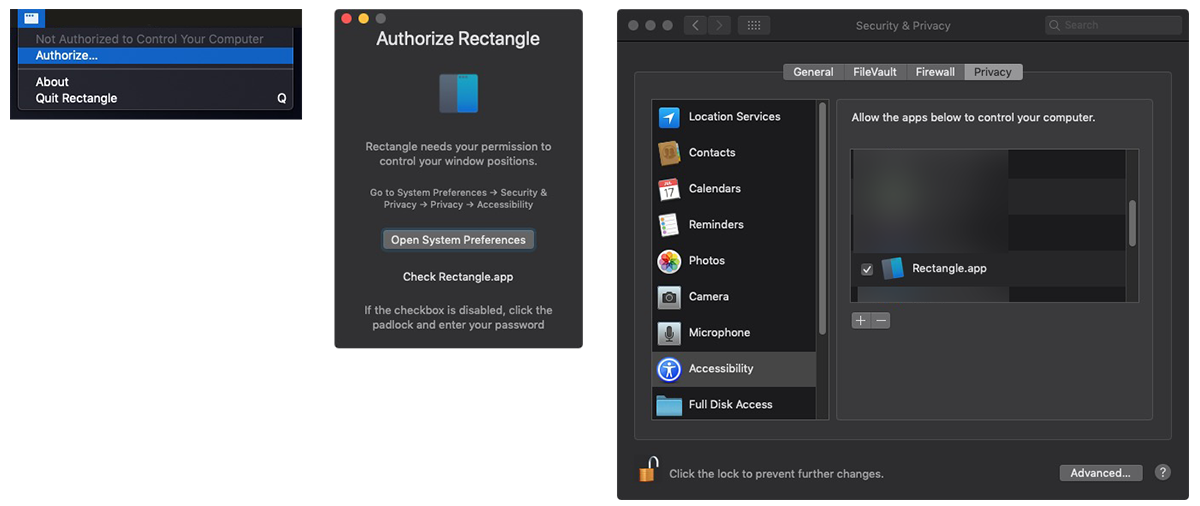
This screenshot is from the original 2019 article. The macOS settings interface has since changed.
Once authorized, Rectangle is ready to use.
Rectangle Keyboard Shortcuts
Rectangle’s keyboard shortcuts are probably its biggest selling point. Instead of manually dragging and resizing windows, you can reposition them with a single key combination.
Open Rectangle’s settings and select the Shortcuts tab to see the available window actions and their assigned shortcuts.

Rectangle’s original settings interface. Version 2.0 introduced a redesigned settings window.
For example, you can configure the following keyboard shortcuts:
| Window action | Example shortcut |
|---|---|
| Left half | Control + Option + Left Arrow |
| Right half | Control + Option + Right Arrow |
| Top half | Control + Option + Up Arrow |
| Bottom half | Control + Option + Down Arrow |
| Maximize | Control + Option + Return |
| Center | Control + Option + C |
| Restore | Control + Option + Delete |
These are example assignments rather than universal defaults. Your shortcuts may differ depending on whether you selected Rectangle’s recommended configuration, Spectacle’s shortcuts or your own custom settings.
If you’re moving from Spectacle, Rectangle can also use its familiar keyboard shortcut configuration.
Window Snapping With Your Mouse
If keyboard shortcuts aren’t your thing, Rectangle can also resize windows when you drag them toward specific areas of your screen.
With window snapping enabled, a preview appears indicating where the window will be positioned when you release it.
| Snap area | Window position |
|---|---|
| Left edge | Left half |
| Right edge | Right half |
| Top edge | Maximized |
| Screen corners | Corresponding quarter |
| Bottom left, center or right | Corresponding third |
You can customize the available snapping areas or disable mouse snapping entirely if you prefer managing windows exclusively with your keyboard.
What’s New in Rectangle 2.0?
Released in September 2026, Rectangle 2.0 introduced a redesigned settings interface while retaining the application’s straightforward approach to window management.
The updated interface separates keyboard shortcuts, snapping areas, window behavior and application settings into dedicated tabs.
Recent improvements include:
- Arrange multiple windows into rows or columns and cycle through different grid layouts.
- Optional animations when moving and resizing windows.
- A blurred snapping preview.
- An optional setting to restore a maximized window by repeating the Maximize shortcut.
- Support for assigning mouse buttons to window actions.
- Additional window layouts and appearance improvements for macOS 27.
The complete release history is available on GitHub.
Rectangle vs Built-in macOS Window Tiling
When this article was originally published, macOS offered relatively limited window management capabilities outside of Split View.
That changed with macOS Sequoia, which introduced native window tiling, including edge snapping, keyboard shortcuts and additional layouts accessible through the green window button.
For basic window organization, the built-in macOS window tiling features may now be all you need.
Rectangle remains useful if you want more control over keyboard shortcuts, additional window sizes and positions, configurable snapping areas or more flexibility when working with multiple displays.
If you enable Rectangle’s mouse snapping, consider disabling macOS’s own edge tiling options under System Settings > Desktop & Dock to avoid conflicts between the two utilities.
There are some limitations. Rectangle cannot override an application’s minimum window size, and the free version cannot move windows between different macOS Spaces.
Rectangle vs Rectangle Pro
The developer also offers Rectangle Pro, a separate commercial application that builds upon the free version.
Rectangle Pro adds advanced mouse gestures, custom window sizes and positions, saved application layouts and the ability to temporarily stash windows outside the visible screen.
Unlike Rectangle, Rectangle Pro is closed source.
For everyday window snapping and keyboard-driven window management, the free version is more than capable. There is no requirement to upgrade.
If you’re also looking to organize your Mac’s menu bar, check out Hidden Bar, another lightweight, free and open source macOS utility.
Download: Official website | Source code